Virtual Reality for
Corporate Training
While VR has been around for decades, corporations have only recently begun to experiment with it as a training tool. Furthermore, it is logical. According to research, virtual reality training results in increased trainee retention and engagement when compared to traditional learning methods (DeBell, 2020). Virtual reality training is "one of the most secure, controlled, dependable, and effective methods available for humans to acquire new knowledge and skills" (DeBell, 2020).
What is Virtual Reality Training and Why Is It Necessary?
Virtual immersion training creates the ideal learning environment. Why? Humans learn most effectively when they physically perform a task, receive feedback on their errors, adjust their strategy, and re-attempt the task. Numerous these training experiences are unsuitable for real-world application (Thompson, 2017). "Experiential learning has long been touted as the most effective method of learning, with studies indicating that it improves learning quality and retention by 75-90 percent" (Thompson, 2017).
In a virtually simulated scenario, a learner can repeatedly practice tasks exactly as they would in the physical world. The price is set in stone. The number of repetitions is unlimited. Additionally, research indicates that employees retain information twice as well as they do from training videos or text-based learning experiences when they participate in VR training (DeBell, 2020).
Virtual reality learning is effective because of a process called sensory immersion. That is, immersing your senses completely in a virtual environment. When a virtual environment appears, feels, and sounds authentic, the human brain processes the information as if it were real. It is oblivious to the distinction (DeBell, 2020).
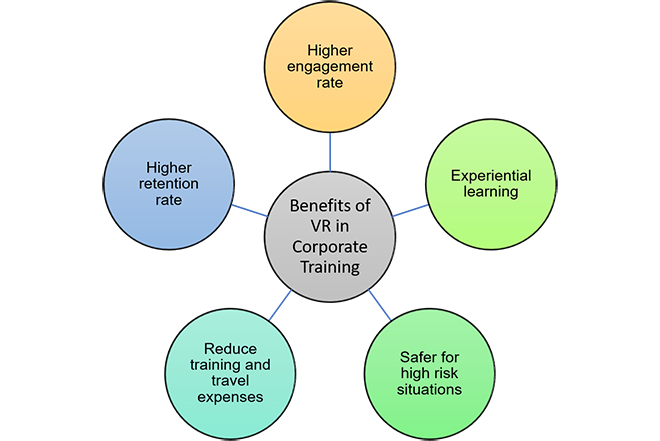
The case for using VR in corporate training is straightforward: it can boost employee engagement and knowledge retention while also training employees in a safer, more cost-effective manner (Thompson, 2017).
How is Virtual Reality Applied to Training?
Virtual reality is being used to improve the skills of people in a variety of professions, from Walmart cashiers to NFL quarterbacks.
Notable industries that were early adopters of virtual training included those with a high risk of injury or death. Military, healthcare, and manufacturing are just a few examples. Hands-on physical training is prohibitively expensive and difficult to replicate in all occupations. A single unintentional error can lead to a fatal accident.
Virtual reality training, on the other hand, isn't just for high-risk jobs. Many businesses around the world are utilizing virtual reality to improve employee effectiveness and efficiency.
Large-scale retailers in the United States, such as Walmart, are using virtual reality to train in-store associates on how to interact with customers (DeBell, 2020). Associates put on a headset and enter a virtual store to practice greeting customers and handling customer complaints.
This innovative learning technology is also being used to help employees develop soft skills. Change management, leadership, empathy, and creativity are all in high demand in today's labor market. PwC began by developing a training program that immersed employees in a rich content environment. Employees were tasked with providing feedback to coworkers, facilitating meetings, and resolving disputes with difficult managers (DeBell, 2020).
Examples of VR Training in
Three Different Industries:
Benefits of VR training
Thompson, S. (2017, August 2). VR for Corporate Training: Examples of VR already being used. Virtualspeech.com; VirtualSpeech. https://virtualspeech.com/blog/how-is-vr-changing-corporate-training
1. Allows for an infinite number of repetitions
VR training allows for an infinite number of repetitions. On-the-job practice that is ongoing and helps to significantly improve skill attainment.
2. Provides an opportunity for hands-on learning
VR training offers a completely immersive experience. The learner is immersed in a realistic scenario. Knowledge retention is rapidly increased by performing actual tasks in a virtual space. When compared to any traditional format, the learning experience provided by virtual reality is unrivaled.
3. Establishes a secure and controlled learning environment
Many job-related skills can be hazardous to practice. VR creates a risk-free training environment. It is completely safe and controlled, with no risk of injury. In a virtually controlled environment, all situations that would normally be dangerous can be practiced safely.
4. It enhances memory retention and recall.
According to recent research, memory retention from a VR experience is two times higher than traditional text-based learning materials. VR training appears to improve information retention by utilizing a person's spatial awareness – the position of their body and the way they move around the world.
5. Enables complete remote training
Training is now available from any location. When compared to traditional classroom learning, the technology eliminates all time and location constraints. With adaptable software, new training programs can be uploaded and distributed to thousands of employees with a few mouse clicks.
6. Reduces training costs on a larger scale.
Corporate training in the traditional sense is costly. Companies must spend a lot of money to send employees all over the world to attend in-person workshops. Hotels, flights, and meals are all expenses. All of this comes at a hefty cost. Virtual reality training is a viable option. While the initial outlay is greater than for traditional learning methods, it can save money in the long run. According to PwC research, if a company has 3,000 learners, VR training is 52 percent less expensive than classroom training. The greater the number of employees trained, the greater the return on VR training (Thompson, 2017).
Takeaway
It's safe to say that virtual reality training is here to stay. This secure, dependable, and effective mode of instruction has benefited hundreds of organizations. Virtual reality is only scratching the surface of its potential, with a projected growth rate of 48 percent or more over the next five years. Prepare for the future of training as we enter a world of limitless opportunity.